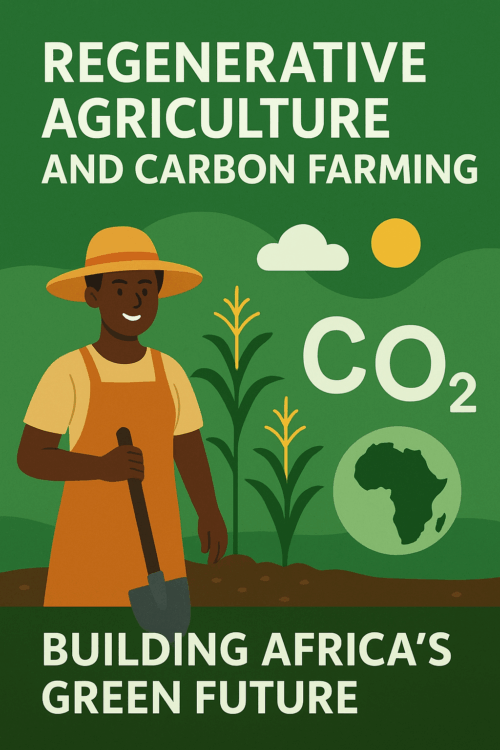
Regenerative Agriculture and Carbon Farming: Building Africa’s Green Future










Introduction – The Green Future of African Agriculture
Across Africa, a new wave of farmers and entrepreneurs is redefining agriculture through regenerative farming and carbon sequestration. These innovative practices restore soil health, increase productivity, and help combat climate change. As the world shifts toward sustainability, Africa stands at the forefront of a green revolution — driven by innovation, impact, and opportunity.
Understanding Regenerative Agriculture
What It Is and Why It Matters
Regenerative agriculture is more than just a sustainable practice — it’s a holistic system that rebuilds soil health, enhances biodiversity, and improves water retention. Unlike traditional farming, which often depletes soil nutrients, regenerative farming restores ecological balance through natural processes such as crop rotation, cover cropping, and reduced tillage.
This approach not only produces healthier food but also strengthens the resilience of farms against drought and pests, creating a win-win for people and the planet.
Environmental and Economic Benefits
Healthy soil means higher yields and more stable ecosystems. Regenerative methods improve soil structure, increase carbon capture, and reduce dependence on chemical fertilizers. Economically, it lowers input costs and builds climate resilience — vital for African farmers facing unpredictable weather and degraded land.
The Rise of Carbon Farming in Africa
Turning Soil Carbon into Income
Carbon farming allows African farmers to earn income by capturing carbon in their soils. Through techniques like agroforestry and composting, farmers enhance soil organic carbon — and the amount captured can be converted into carbon credits for sale on international markets.
By participating in verified carbon programs, smallholder farmers can monetize sustainable practices, diversifying their income and strengthening rural economies.
Key Initiatives and Partners
Organizations such as FAO, UNDP, GIZ, and the Green Climate Fund (GCF) are leading efforts to promote carbon farming across Africa. In Ghana, the Savannah Climate-Smart Agriculture Program supports farmers in regenerating degraded land. In Kenya, projects like the Northern Kenya Rangelands Carbon Project have already generated millions in carbon revenue. Meanwhile, in Nigeria, youth-led startups are digitizing carbon tracking for small-scale farmers.
Technology Driving Regenerative Agriculture
Measuring Soil and Carbon Health
Technology plays a vital role in scaling regenerative agriculture. Remote sensing, satellite imagery, and IoT soil sensors are revolutionizing how carbon levels are measured and verified. Startups such as SoilDoc, CarbonSpace, and Agridrive are creating affordable tools that provide real-time soil health data for farmers and investors alike.
Blockchain and Data Transparency
Blockchain technology ensures transparency and traceability in carbon markets. It allows smallholder farmers to register their carbon credits securely, preventing fraud and ensuring fair compensation. This digital verification is key to building trust and attracting global investors to Africa’s green economy.
Green Finance and Investment Opportunities
Funding Carbon and Regenerative Projects
The rise of green finance has opened new funding pathways for Africa’s agricultural sector. Development agencies like GIZ, UNDP, and Climate Finance Accelerator provide grants, while private investors are exploring impact-driven carbon ventures. The World Bank and Green Climate Fund also support regional projects that combine carbon farming, food security, and job creation.
Opportunities for Entrepreneurs
Entrepreneurs can leverage these programs to launch carbon farming startups, build soil health platforms, or partner with cooperatives to scale sustainable production. With climate finance expanding, Africa’s agritech innovators are well-positioned to capture both profit and purpose in this growing market.
Challenges and Solutions
Certification and Verification Barriers
Despite its promise, carbon farming faces challenges in certification and verification. Many smallholder farmers lack access to the tools or expertise needed to measure carbon accurately. Verification costs remain high, often limiting participation to large-scale projects.
Cooperative and Digital Solutions
To address this, farmer cooperatives and agri-startups are developing shared carbon monitoring systems. By pooling resources, smallholders can access certification, training, and market entry — ensuring equitable participation in Africa’s green transition.
African Success Stories
Regenerative Farming Pioneers
From Ghana to Kenya and Nigeria, green entrepreneurs are leading Africa’s agricultural transformation. In Ghana, Agri-Impact Consult trains farmers in regenerative techniques that boost yields while restoring soil fertility. Kenya’s Komaza Forestry empowers smallholders to grow trees for carbon storage, while Nigerian startup Releaf uses AI to improve regenerative palm oil processing.
Women and Youth Leading the Change
Women and young innovators are at the heart of Africa’s soil regeneration story. Initiatives like Kenya’s Mukuru Clean Stoves, led by women entrepreneurs, and Ghana’s Youth Climate Innovation Lab showcase how inclusive innovation drives both sustainability and social impact.
Starting a Regenerative Agribusiness in 2025
Skills and Partnerships Needed
To build a regenerative agribusiness, entrepreneurs need skills in climate-smart agriculture, data analysis, and project management. Partnering with organizations like FAO, UNDP, or local agricultural innovation hubs can provide training and mentorship.
Steps to Launch
- Identify suitable crops and regions for regenerative practices.
- Register with a verified carbon platform (such as Verra or Gold Standard).
- Access funding through green investment or development grants.
- Build partnerships with cooperatives or agritech startups.
By combining knowledge, collaboration, and innovation, entrepreneurs can turn regenerative agriculture into a profitable, purpose-driven business.
The Future of Regenerative Agriculture and Carbon Farming in Africa
Digital Transformation and Smart Agriculture
The next frontier for regenerative agriculture lies in digital innovation. With Africa’s rising mobile connectivity and fintech adoption, farmers can now access training, financing, and marketplaces through their smartphones.
Platforms like AgroCenta (Ghana), Twiga Foods (Kenya), and Hello Tractor (Nigeria) are revolutionizing agribusiness by combining sustainability with technology — connecting smallholder farmers to buyers, investors, and climate data.
In the carbon farming space, AI-powered soil analytics, satellite tracking, and mobile payment systems are helping farmers record their climate-positive practices and get paid faster for carbon credits. This convergence of technology and sustainability is what will define Africa’s next agricultural revolution.
The Policy and Ecosystem Shift
Governments across Africa are beginning to recognize the power of regenerative agriculture in achieving food security and climate resilience. Ghana’s Ministry of Food and Agriculture, for instance, has introduced programs integrating regenerative principles into national farming strategies.
International development agencies — including FAO, UNDP, and GIZ — are aligning their agricultural programs with carbon farming incentives, enabling farmers to benefit from global climate financing frameworks.
The establishment of carbon registries and digital land verification systems will make it easier for African farmers to access certification and international carbon markets, bridging the gap between local action and global impact.
Entrepreneurship Opportunities in the Green Economy
Africa’s regenerative agriculture space is fertile ground for innovation and entrepreneurship. Visionary entrepreneurs can explore opportunities in:
- 🌱 Soil restoration services – providing biofertilizers, composting systems, and regenerative inputs.
- ☁️ Carbon measurement and verification – building affordable carbon tracking platforms.
- 💸 Green finance facilitation – connecting farmers to climate funds and investors.
- 🛰️ Agri-data and AI platforms – integrating remote sensing with farm management tools.
- 🤝 Community agribusiness cooperatives – creating shared ownership models that scale impact.
These business models not only contribute to Africa’s sustainable development goals (SDGs) but also offer long-term financial viability, especially as global consumers and corporations demand traceable, carbon-neutral products.
Case Study: Ghana’s Leadership in Regenerative Agriculture
Local Innovation with Global Vision
In Ghana, regenerative agriculture is being embraced by agripreneurs who see sustainability as both a moral and economic mission. Projects such as the Savannah Agriculture Research Institute’s soil regeneration programs and Agrihouse Foundation’s Women in Food and Agriculture Leadership Training Forum (WOFAGRIC) highlight how local collaboration can produce measurable impact.
Additionally, impact investors and development partners are targeting Ghana as a pilot hub for scalable carbon farming initiatives due to its policy stability, innovation ecosystem, and youth-driven agricultural ventures.
Empowering the Next Generation of Green Entrepreneurs
Africa’s youth are increasingly viewing agriculture as a technology-enabled business, not a subsistence activity. Regenerative farming offers them the chance to contribute to environmental restoration while building scalable ventures.
Through digital platforms, mentorship programs, and green funding access, the next generation of entrepreneurs can lead Africa’s carbon-positive transition — turning degraded lands into thriving ecosystems and new income streams.
Toward a Carbon-Positive Africa
Regenerative agriculture and carbon farming are not just environmental solutions — they are economic opportunities that empower African farmers, protect biodiversity, and build resilient economies.
As global demand for carbon offsets grows, Africa’s fertile lands and innovative entrepreneurs have the potential to lead the world in climate-smart food systems.
The future of farming is regenerative, and Africa is planting the seeds today. 🌍🌱
Conclusion: Regenerating Africa, One Farm at a Time
Regenerative agriculture and carbon farming represent a paradigm shift for Africa’s economy. Beyond improving yields and livelihoods, they offer a blueprint for climate resilience, green innovation, and inclusive growth.
As the world races toward carbon neutrality, Africa’s farmers, innovators, and investors are proving that sustainability and profitability can grow together.
From Ghana’s fertile farmlands to Kenya’s digital farms and Nigeria’s carbon startups, a new generation of African changemakers is sowing the seeds of a regenerative, resilient, and prosperous future. 🌍💚