Common Challenges, Mistakes to Avoid, Sustainability, Future Opportunities, and Expert Tips
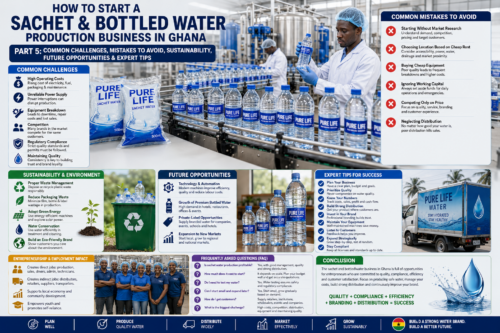










The sachet and bottled water business can be profitable, but like any other enterprise, it comes with challenges. Entrepreneurs must be prepared to manage regulatory requirements, production costs, competition, equipment breakdowns, and changing customer expectations.
Building a successful water production company requires a long-term approach. The goal should not only be to produce and sell water but to establish a trusted brand with strong operational systems, reliable distribution, and consistent quality.
Common Challenges and How to Overcome Them
High Operating Costs
Electricity, fuel, packaging materials, transportation, labour, and equipment maintenance can significantly affect profitability.
To manage these expenses:
- Monitor your production costs regularly.
- Reduce unnecessary wastage.
- Maintain equipment to prevent costly breakdowns.
- Compare suppliers before purchasing materials.
- Track fuel and energy consumption.
- Review your pricing when major costs increase.
Good financial management is essential for protecting profit margins.
Unreliable Power Supply
Production equipment may depend heavily on electricity. Power interruptions can result in production delays and lost sales.
Businesses can reduce this risk by considering appropriate backup power solutions and maintaining critical equipment properly.
However, entrepreneurs should calculate the cost of alternative power sources carefully before investing.
Equipment Breakdown
A breakdown can stop production and affect customer relationships.
Preventive maintenance is one of the best ways to reduce downtime.
Businesses should:
- Follow manufacturer maintenance schedules.
- Train employees to operate machinery correctly.
- Keep records of repairs and servicing.
- Stock critical spare parts where practical.
- Work with reliable technicians.
Competition
The water production industry is highly competitive, particularly in densely populated urban areas.
Instead of competing only on price, businesses should focus on:
- Consistent product quality
- Reliable distribution
- Strong branding
- Excellent customer service
- Professional packaging
- Availability
A trusted brand can command customer loyalty even in a competitive market.
Regulatory Compliance
Water production is a regulated business because the product is consumed by humans. Failure to meet applicable requirements can damage your reputation and expose your business to regulatory action.
Entrepreneurs should stay informed about current requirements and maintain proper documentation.
Compliance should be treated as an ongoing responsibility rather than a one-time activity.
Maintaining Consistent Quality
Producing safe water once is not enough. Quality must remain consistent throughout the life of the business.
Regular quality checks, proper sanitation, staff hygiene, equipment maintenance, and appropriate storage practices are essential.
Common Mistakes Beginners Should Avoid
Starting Without Proper Market Research
Some entrepreneurs purchase equipment before determining whether sufficient demand exists in their target market.
Before investing, research:
- Customer demand
- Competitor brands
- Pricing
- Distribution channels
- Production capacity requirements
Understanding the market can help you avoid overinvesting in a location with limited opportunities.
Choosing a Location Based Only on Cheap Rent
A low-cost facility may appear attractive, but poor accessibility or unsuitable infrastructure can create serious problems.
Consider:
- Road access
- Water availability
- Electricity
- Drainage
- Sanitation
- Storage space
- Proximity to customers
The cheapest location is not always the most profitable.
Buying Cheap Equipment
Low-cost machinery may reduce initial investment but could result in higher maintenance costs and frequent production interruptions.
Compare equipment based on:
- Quality
- Capacity
- Durability
- Energy efficiency
- Availability of spare parts
- After-sales support
A reliable machine can be more valuable than a cheap machine that frequently breaks down.
Ignoring Working Capital
Some entrepreneurs spend most of their money on equipment and have little cash left for daily operations.
Remember to budget for:
- Packaging materials
- Salaries
- Utilities
- Fuel
- Maintenance
- Transportation
- Marketing
Adequate working capital is essential for keeping the business running during the early stages.
Competing Only on Price
Lowering prices excessively can reduce profitability and make it difficult to maintain quality.
Instead, focus on delivering value through:
- Quality
- Reliability
- Availability
- Customer service
- Professional branding
Neglecting Distribution
Producing water without a clear distribution strategy can lead to unsold inventory.
Develop your distribution network before significantly increasing production capacity.
Sustainability and Environmental Responsibility
The water production industry faces increasing attention regarding plastic waste.
Sachet film and plastic bottles can contribute to environmental pollution when improperly disposed of.
Businesses can contribute to environmental sustainability by adopting responsible practices.
Improve Waste Management
Businesses should properly manage:
- Production waste
- Damaged packaging
- Plastic materials
- Chemical containers
- Other industrial waste
Where feasible, partner with approved waste collection and recycling organizations.
Reduce Packaging Waste
Efficient production processes can help minimize packaging waste.
Businesses should monitor:
- Film wastage
- Damaged bottles
- Defective labels
- Packaging errors
Reducing waste can benefit both the environment and the company’s bottom line.
Explore Sustainable Practices
Depending on the scale of operations, businesses can consider:
- Energy-efficient machinery
- Solar power solutions
- Water conservation
- Recycling initiatives
- Reusable transport materials
Sustainability can also strengthen a company’s reputation among environmentally conscious customers.
The Future of the Water Production Industry in Ghana
The packaged drinking water industry is likely to continue evolving as consumer expectations, technology, and environmental concerns change.
Technology and Automation
Modern production equipment can improve:
- Production speed
- Packaging consistency
- Quality control
- Labour efficiency
- Inventory management
As businesses grow, automation may help them increase production while maintaining consistent standards.
However, entrepreneurs should invest in technology based on actual business needs rather than purchasing expensive machinery simply for the sake of automation.
Growth of Premium Bottled Water
As Ghana’s middle class and hospitality sector continue to develop, opportunities may increase for premium bottled water brands.
Potential markets include:
- Hotels
- Restaurants
- Corporate offices
- Conferences
- Airports
- High-end events
Businesses that combine quality, attractive packaging, and strong branding may find opportunities in this segment.
Private-Label Opportunities
Private-label water production can create additional opportunities for manufacturers.
Companies and organizations may want customized water bottles featuring their:
- Logo
- Brand name
- Event details
- Corporate identity
This can be particularly attractive for conferences, weddings, hotels, and corporate events.
Expansion Into New Markets
A successful business can gradually expand beyond its original location.
Expansion opportunities may include:
- Nearby communities
- Other districts
- Regional markets
- National distribution
However, expansion should happen only after establishing strong production, financial, and distribution systems.
Entrepreneurship and Employment Opportunities
The water production industry can create employment directly and indirectly.
Direct employment opportunities may include:
- Production workers
- Machine operators
- Quality control personnel
- Drivers
- Sales representatives
- Marketing staff
- Administrative workers
- Maintenance technicians
Indirect opportunities can also emerge for:
- Distributors
- Wholesalers
- Retailers
- Packaging suppliers
- Equipment technicians
- Transport operators
- Recycling businesses
As more businesses enter the industry and existing companies expand, the sector can contribute to employment and economic activity.
Expert Tips for Building a Successful Water Production Business
If you want to build a sustainable water production business in Ghana, consider the following principles.
Start With a Clear Business Plan
Understand your market, costs, customers, and revenue model before investing.
Prioritize Quality
Never compromise on water safety or hygiene to reduce costs.
Know Your Numbers
Track production costs, sales, expenses, cash flow, and profit regularly.
Build Strong Distribution
Your products should be available where your customers shop and consume them.
Invest in Your Brand
A professional brand can help differentiate your products from competitors.
Maintain Your Equipment
Preventive maintenance is less expensive than repeated emergency repairs and production downtime.
Listen to Customers
Customer feedback can reveal opportunities to improve your products and services.
Expand Strategically
Do not increase production capacity faster than your market can absorb.
Stay Compliant
Keep up with applicable regulations and maintain all necessary approvals.
Frequently Asked Questions About Water Production in Ghana
Is sachet water production profitable in Ghana?
Sachet water production can be profitable when the business has sufficient demand, efficient production, effective cost control, and reliable distribution. Profitability varies based on location, production capacity, selling price, operating costs, and competition.
How much money do I need to start a water production business?
The amount required varies significantly depending on the scale of the operation. Major expenses include facility setup, water treatment equipment, packaging machinery, regulatory requirements, working capital, and distribution.
Entrepreneurs should prepare a detailed budget and obtain current quotations before investing.
Is bottled water more profitable than sachet water?
Not necessarily. Bottled water may offer higher selling prices and stronger branding opportunities, while sachet water typically benefits from high-volume demand. The more profitable option depends on your target market, production costs, pricing, and distribution strategy.
Do I need to test my water before starting production?
Yes. Water quality testing is an essential part of establishing an appropriate treatment process and ensuring that the finished product meets applicable requirements.
Can I start with sachet water and add bottled water later?
Yes. Businesses can begin with one product line and expand as demand, financial resources, and operational capacity increase.
How can I get customers for my water production business?
Potential strategies include supplying retailers, wholesalers, institutions, hotels, restaurants, event organizers, and corporate organizations. Building a strong distribution network and maintaining reliable delivery can help increase sales.
How can I compete with established water brands?
Focus on consistent quality, professional branding, reliable availability, customer service, and effective distribution. You can also identify underserved markets where established brands have limited presence.
What is the biggest challenge in the water production business?
Challenges vary by business, but common issues include operating costs, competition, equipment breakdowns, distribution difficulties, regulatory compliance, and maintaining consistent quality.
Conclusion: Is Water Production a Good Business Opportunity in Ghana?
Sachet and bottled water production remains an attractive business opportunity for entrepreneurs who are willing to invest in quality, compliance, efficient operations, and strong distribution.
However, success is not guaranteed simply because demand for drinking water is high. The industry requires careful planning, proper water treatment, reliable equipment, effective financial management, and consistent attention to customer needs.
For aspiring entrepreneurs, the best approach is to start with thorough market research and a realistic business plan. Understand your target customers, evaluate your competition, identify your water source, confirm applicable regulatory requirements, and calculate your expected costs before making major investments.
Once operations begin, focus on producing a consistently high-quality product and building a reliable distribution network. Your ability to get the product into the hands of consumers can be just as important as your ability to produce it.
As the business grows, consider opportunities to expand into bottled water, private-label production, institutional supply, and new geographic markets. However, expansion should be based on proven demand and a financially sustainable business model.
Ultimately, the most successful water production businesses are likely to be those that combine quality, compliance, efficient production, strong branding, and reliable distribution.
If you are considering starting a sachet or bottled water business in Ghana, the opportunity is worth exploring—but approach it as a serious manufacturing venture. Research the market, plan your finances, comply with the rules, prioritize quality, and build your distribution network.
With the right strategy and disciplined execution, a water production business can become a sustainable enterprise that serves communities, creates jobs, and generates long-term economic value.