Operating Costs, Profitability, Distribution, and Marketing Your Water Production Business in Ghana
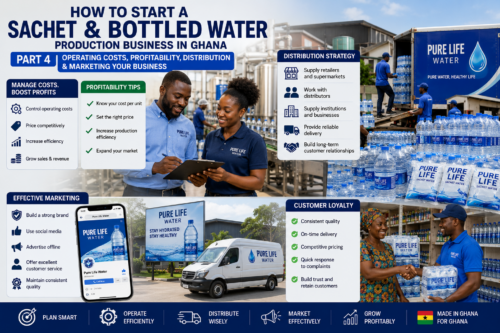










Starting a sachet or bottled water production business is only the beginning. After setting up your facility and beginning production, the next challenge is to operate efficiently, generate consistent sales, and build a strong distribution network.
A water production business can have high sales volumes, but profitability depends on how well you manage production costs, pricing, distribution, and customer relationships. Entrepreneurs who control expenses and build efficient sales channels are more likely to achieve sustainable growth.
Operating Costs
Understanding your operating expenses is essential for managing cash flow and determining the profitability of your business.
Your costs can generally be divided into fixed and variable expenses.
Fixed Expenses
Fixed expenses are costs that generally remain relatively stable regardless of how much water you produce.
These may include:
- Facility rent or lease payments
- Salaries for permanent employees
- Equipment depreciation
- Security services
- Insurance
- Administrative expenses
- Software and accounting services
Understanding these costs helps you determine the minimum level of sales your business needs to remain operational.
Variable Expenses
Variable costs increase as production increases.
They may include:
- Water treatment chemicals and consumables
- Sachet film
- PET bottles
- Bottle caps
- Labels
- Packaging materials
- Electricity
- Fuel
- Vehicle maintenance
- Distribution expenses
- Equipment repairs
Careful monitoring of variable costs is particularly important because small increases in production expenses can significantly affect profit margins when operating at high volumes.
Utility and Energy Costs
Electricity is an important consideration for water production businesses because treatment and packaging equipment may operate for several hours each day.
Entrepreneurs should budget for:
- Electricity
- Water pumping
- Fuel for generators
- Equipment servicing
A reliable backup power system can help prevent production interruptions, especially when power outages affect operations.
However, businesses should compare the cost of alternative energy solutions and choose options that make financial sense for their production scale.
Revenue, Pricing, and Profitability
Generating revenue is not the same as generating profit. A successful entrepreneur must understand the relationship between production volume, selling price, operating costs, and distribution expenses.
Calculate Your Cost Per Unit
Before setting your selling price, calculate the total cost of producing one unit of your product.
Your calculation should consider:
- Raw water costs
- Treatment costs
- Packaging
- Labour
- Electricity
- Fuel
- Maintenance
- Transportation
- Administrative expenses
For example, if you produce sachet water, you should determine the approximate cost of producing one sachet or one bag of sachets.
For bottled water, calculate the cost per bottle, pack, or carton depending on how you sell the product.
Set Competitive Prices
Your selling price should cover your production costs while providing a reasonable profit margin.
However, pricing should also reflect:
- Competitor prices
- Customer purchasing power
- Distribution costs
- Product quality
- Brand positioning
- Location
Avoid setting your prices too low simply to attract customers. Unsustainable pricing can create cash flow problems and make it difficult to maintain quality.
Wholesale vs. Retail Pricing
Many water producers use different prices for different customers.
For example:
- Factory price
- Distributor price
- Wholesale price
- Retail price
Distributors and wholesalers typically purchase larger quantities and may receive lower prices per unit.
Although your profit margin per unit may be lower for bulk orders, large-volume sales can generate significant revenue and improve production efficiency.
Break-Even Analysis
A break-even analysis helps you determine how much you need to sell before your business starts generating profit.
You should consider:
- Fixed costs
- Variable costs
- Selling price
- Average sales volume
Knowing your break-even point helps you set realistic sales targets and evaluate whether your business model is financially sustainable.
Distribution and Sales Strategy
One of the biggest challenges in the water production business is distribution.
You can produce excellent water, but if your products are not easily available to consumers, sales will remain limited.
Sell Directly to Retailers
You can supply products directly to:
- Provision shops
- Supermarkets
- Mini marts
- Restaurants
- Food vendors
- Drinking spots
- Pharmacies
- Fuel stations
Direct distribution allows you to build relationships with retailers and understand customer demand.
Work With Distributors
Distributors can help you reach a wider market without requiring you to manage every delivery yourself.
A good distributor can supply multiple retailers across different communities.
When selecting distributors, consider:
- Reliability
- Market coverage
- Payment history
- Transportation capacity
- Existing customer relationships
Clear agreements on pricing, payment terms, and delivery schedules can help prevent misunderstandings.
Supply Institutions
Institutional customers can provide recurring sales.
Potential customers include:
- Schools
- Hospitals
- Hotels
- Churches
- Corporate offices
- Restaurants
- Event companies
Approach these organizations with professional proposals and competitive pricing.
Supply Events
Events represent another important sales opportunity.
You can supply water for:
- Weddings
- Funerals
- Conferences
- Festivals
- Religious programs
- Sporting events
- Corporate events
Building relationships with event planners can help you secure recurring bulk orders.
Use Delivery Services
A reliable delivery system can become a competitive advantage.
Customers value businesses that deliver products:
- On time
- In good condition
- At predictable prices
As your business grows, consider investing in branded delivery vehicles to increase visibility while transporting products.
Branding and Marketing
Water is a highly competitive product. Strong branding can help your business stand out and build customer trust.
Create a Strong Brand Identity
Your brand should have:
- A memorable name
- Professional logo
- Attractive packaging
- Consistent colours
- Clear product information
Your packaging should communicate cleanliness, safety, and professionalism.
Build Consumer Trust
Consumers are more likely to buy products from brands they trust.
Build trust by:
- Maintaining consistent quality
- Keeping your production facility hygienic
- Following applicable regulations
- Responding to customer complaints
- Ensuring reliable product availability
A single quality issue can damage a brand’s reputation, so quality control should always remain a priority.
Use Social Media Marketing
Social media can help water businesses increase visibility and connect with customers.
Platforms such as Facebook, Instagram, TikTok, LinkedIn, and WhatsApp can be used to promote:
- New products
- Corporate partnerships
- Event supply services
- Distribution opportunities
- Company milestones
- Community activities
WhatsApp can be particularly useful for communicating with retailers and distributors and receiving orders.
Use Offline Marketing
Traditional marketing remains valuable, particularly for businesses serving local communities.
Consider:
- Branded delivery vehicles
- Posters
- Flyers
- Shop signage
- Branded umbrellas
- Retailer partnerships
- Community sponsorships
Your delivery vehicles can serve as moving advertisements while transporting products.
Build Strategic Partnerships
Partnerships can help you access new customers.
Consider working with:
- Event planners
- Hotels
- Restaurants
- Schools
- Supermarkets
- Corporate organizations
- Wholesalers
- Distributors
Strategic partnerships can create recurring demand and strengthen your market position.
Customer Retention and Brand Loyalty
Acquiring customers is important, but retaining them is even more valuable.
Customers are more likely to remain loyal when you provide:
- Consistent quality
- Reliable delivery
- Competitive pricing
- Professional customer service
- Quick responses to complaints
You can also create incentives for high-volume customers, such as discounts or preferred delivery arrangements, where commercially viable.
Keep records of your major customers and regularly follow up with them. Simple relationship management can make a significant difference in a competitive market.
How to Increase Profitability
Increasing sales is not the only way to improve profitability. Businesses can also increase profits by reducing waste and improving efficiency.
Improve Production Efficiency
Monitor your production process to identify:
- Material wastage
- Equipment downtime
- Excessive energy consumption
- Packaging losses
- Labour inefficiencies
Reducing unnecessary waste can improve your profit margins without increasing your selling price.
Maintain Equipment
Preventive maintenance can help reduce unexpected breakdowns.
A broken machine can lead to:
- Production delays
- Lost sales
- Emergency repair costs
- Customer dissatisfaction
Schedule regular maintenance and keep essential spare parts available where practical.
Increase Production Volume Carefully
Higher production volumes can reduce the average cost per unit, but increasing capacity without sufficient demand can create unnecessary expenses.
Before expanding production, confirm that you have:
- Reliable customers
- Adequate storage
- Sufficient distribution capacity
- Enough working capital
Growth should be driven by market demand rather than simply increasing production capacity.
Expand Your Product Range
Once your core business is stable, you may consider introducing additional products.
Depending on your capabilities and regulatory requirements, opportunities may include:
- Bottled water
- Different bottle sizes
- Private-label water
- Bulk water supply
Diversification can help increase revenue and reduce dependence on one product line.
Conclusion
Running a profitable sachet and bottled water production business requires more than producing large volumes of water. Entrepreneurs must carefully manage operating expenses, calculate realistic pricing, build efficient distribution channels, and develop a brand that consumers trust.
The strongest businesses combine quality production with effective sales and distribution. By supplying retailers, institutions, distributors, and event organizers while maintaining consistent product quality, entrepreneurs can build recurring demand and create opportunities for long-term growth.
A well-managed water production business can gradually expand from serving a local community to reaching multiple towns and regions. However, expansion should be based on strong market demand, healthy cash flow, and operational readiness.