The Rise of Digital Agriculture (AgriTech 2.0): Transforming the Future of Farming in Africa










Introduction to AgriTech 2.0
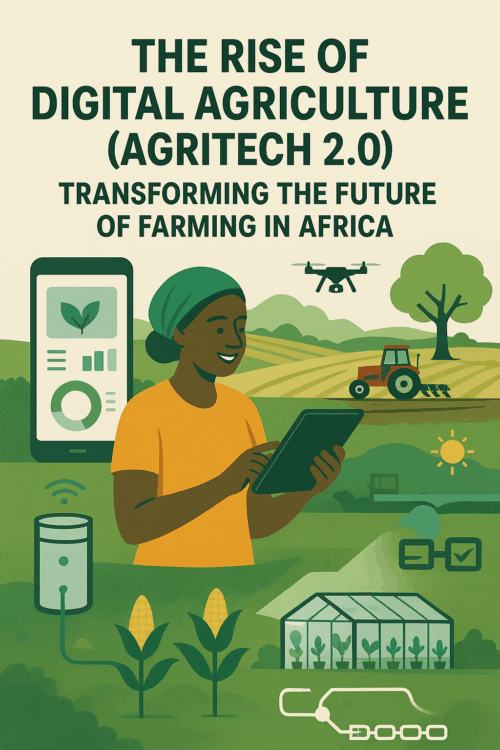
The world is entering a new era of farming—AgriTech 2.0, a digital transformation powered by data, innovation, and connectivity. Across Africa, digital agriculture is redefining how food is grown, distributed, and consumed. With technologies like Artificial Intelligence (AI), IoT, blockchain, and drones, farmers are now able to increase productivity, reduce waste, and make smarter decisions.
Agriculture contributes over 30% of Africa’s GDP and employs more than half of its population. Yet, challenges such as climate change, low yields, and market inefficiencies have long hindered progress. Today, digital tools are helping smallholder farmers access markets, financing, and real-time data—creating a future where technology and sustainability drive Africa’s growth.
Data, AI, and Precision Farming
Predictive Analytics and Smart Irrigation
Data and AI are the backbone of modern agriculture. Predictive analytics allows farmers to anticipate weather changes, soil conditions, and pest outbreaks, enabling better planning and resource management. Smart irrigation systems use AI-driven sensors to deliver water precisely when and where crops need it, reducing water waste and improving crop health.
In Nigeria, Zenvus is leading the way by deploying smart sensors that measure soil quality and nutrient levels. Farmers receive instant data on their mobile devices, helping them make informed decisions about fertilizer use and planting times. This precision farming approach ensures maximum yield while preserving the environment.
Digital Platforms Empowering Farmers
Mobile Apps for Market Access and Financing
In many parts of Africa, smallholder farmers struggle to connect with buyers and financial institutions. Mobile apps and digital platforms are solving this problem by linking farmers directly to markets and investors.
Platforms like AgroCenta in Ghana, Twiga Foods in Kenya, and Farmcrowdy in Nigeria have revolutionized access to finance, logistics, and customers. Farmers can now sell produce online, receive digital payments, and even access loans through FinTech-enabled credit scoring.
These innovations are not only boosting farmer incomes but also enhancing financial inclusion, allowing rural communities to participate in the digital economy.
Smart Farming Technology
Drones, IoT, and Smart Devices
Smart farming technology powered by drones, IoT, and robotics is transforming how farmers manage their land. Drones perform aerial surveys to assess crop health and identify pest infestations. IoT-based sensors track soil moisture, temperature, and crop growth in real time.
A prime example is Hello Tractor, known as the “Uber for Tractors,” which uses GPS and IoT technology to connect farmers with tractor owners. This model increases farm efficiency and makes mechanization affordable for smallholders who previously couldn with tractor owners. This model increases farm efficiency and makes mechanization affordable for smallholders who previously couldn’t afford heavy machinery.
By combining automation with real-time insights, these technologies are helping African farmers work smarter, not harder.
Blockchain and Food Traceability
The global demand for food transparency has made blockchain technology an essential tool in agriculture. By recording every step of the supply chain—from farm to consumer—blockchain ensures traceability, authenticity, and accountability.
In Kenya and Ghana, farmers are using blockchain systems to verify the origin of coffee, cocoa, and fresh produce. Consumers can scan a QR code to learn where and how their food was grown, ensuring fair trade and sustainability.
This transparency builds trust with international buyers, opens up export opportunities, and enhances Africa’s global agribusiness reputation.
Digital Financing and Investment Platforms
Agri-Investment and FinTech Solutions
Access to finance has always been a major barrier for African farmers. Digital financing platforms are breaking down these barriers by connecting farmers to investors through crowdfunding and peer-to-peer lending models.
Platforms like Farmcrowdy (Nigeria) and AgroCenta (Ghana) allow investors to fund specific farm projects and share profits at harvest. Meanwhile, institutions like the World Bank, GIZ, and AGRA are supporting FinTech innovations that provide microloans, crop insurance, and digital wallets to rural farmers.
These efforts are empowering farmers to invest in equipment, seeds, and technology—turning agriculture into a profitable business sector.
African AgriTech Success Stories
Across the continent, AgriTech startups are proving that technology can transform lives and economies.
- Zenvus (Nigeria) – Uses AI to monitor soil and optimize farming inputs.
- AgroCenta (Ghana) – Connects smallholder farmers to digital markets.
- Twiga Foods (Kenya) – Simplifies food distribution using mobile logistics.
- Hello Tractor (Nigeria) – Provides tractor-sharing services through IoT.
- mAgri (Rwanda) – Offers farmers SMS-based advisory and weather updates.
These innovations are empowering millions of farmers and reshaping Africa’s agricultural ecosystem.
Government and Policy Support
Governments across Africa are recognizing the potential of digital agriculture to drive economic growth and food security. Through public-private partnerships, nations like Ghana, Nigeria, and Kenya are investing in digital literacy programs, innovation hubs, and youth training centers.
Organizations such as the African Development Bank, World Bank, and Alliance for a Green Revolution in Africa (AGRA) are also collaborating to expand connectivity and create policies that encourage investment in AgriTech startups.
These initiatives are paving the way for an inclusive and digitally connected agricultural economy.
Challenges in Digital Agriculture
Despite the progress, challenges remain. Limited internet connectivity, digital illiteracy, and high technology costs continue to restrict widespread adoption. Many farmers still lack access to smartphones, affordable data, and stable electricity.
Addressing these issues requires rural broadband expansion, digital skills training, and the development of low-cost agricultural technologies. Governments and private partners must work together to ensure that every farmer—regardless of location or income—benefits from the digital revolution.
The Future of Farming in Africa
The future of farming in Africa is smart, sustainable, and youth-driven. With digital innovation, young entrepreneurs are building startups that promote climate-smart agriculture, renewable energy use, and data-driven decision-making.
As more farmers adopt precision farming and AI-powered tools, Africa’s capacity to feed its population and export to global markets will significantly expand. The continent is on the path to becoming a leader in sustainable agribusiness and technological innovation.
Empowering the Next Generation of Agri-Entrepreneurs
Africa’s agricultural transformation depends on youth engagement and entrepreneurship. With the continent’s population projected to double by 2050, young innovators are redefining agriculture as a tech-driven industry rather than a traditional labor sector.
Initiatives such as AGRA’s Youth in Agribusiness program and AfDB’s ENABLE Youth initiative are nurturing digital entrepreneurs who leverage AI, drones, and blockchain to solve food system challenges. These young innovators are launching apps that connect farmers with buyers, create weather prediction tools, and develop mobile-based advisory services that reach remote areas.
The new generation of AgriTech leaders is not only building profitable ventures but also ensuring that agriculture remains sustainable, inclusive, and adaptable to changing climates.
Sustainability and Climate-Smart Agriculture
As climate change increasingly affects rainfall patterns and soil fertility, sustainability has become the foundation of modern agriculture. AgriTech 2.0 integrates climate-smart technologies to help farmers adapt and mitigate environmental impact.
Solutions such as solar-powered irrigation, AI-driven weather forecasting, and IoT-based water management systems ensure optimal resource use and reduce emissions. Additionally, data analytics allows farmers to identify resilient crop varieties and manage risks more effectively.
Countries like Rwanda and Kenya are leading the shift toward sustainable agribusiness, encouraging regenerative farming practices that preserve biodiversity while boosting productivity.
Women and Digital Inclusion in Agriculture
Women make up nearly half of Africa’s agricultural workforce, yet they face unequal access to land, finance, and technology. Digital agriculture platforms are beginning to close this gap by providing women with tools for productivity and financial independence.
Programs like Agri-wallet and SheFarms are designed to enhance women’s participation in the digital economy. Mobile-based learning platforms and microloan services empower female farmers with knowledge, funding, and connectivity.
Ensuring gender inclusion in AgriTech 2.0 is essential for building equitable and resilient food systems that uplift entire communities.
Regional Collaboration and Innovation Hubs
The growth of digital agriculture in Africa thrives on collaboration between countries, organizations, and private innovators. Regional AgriTech innovation hubs are emerging in Ghana, Kenya, Nigeria, and South Africa, fostering cross-border partnerships and knowledge sharing.
For instance, The Ghana Innovation Hub and Kenya’s Smart Agriculture Platform provide startup incubators, training programs, and funding opportunities. Partnerships between governments and global organizations such as GIZ, World Bank, and FAO are creating ecosystems where startups can test and scale their solutions.
These collaborations are accelerating the adoption of AI-driven agriculture, enhancing productivity, and positioning Africa as a leader in digital food systems.
Digital Agriculture and Export Potential
With improved traceability, productivity, and quality control, Africa’s export potential is growing rapidly. Blockchain-based verification systems allow African products—such as cocoa, coffee, tea, and fruits—to meet international standards international standards and build consumer trust abroad.
Precision farming tools powered by AI and IoT ensure consistent quality and supply, enabling African agribusinesses to compete on the global stage. As trade barriers fall and AfCFTA (African Continental Free Trade Area) expands, digital agriculture will play a vital role in strengthening regional and international exports.
The rise of AgriTech 2.0 is positioning Africa not only as a food-secure continent but also as a global exporter of innovation and sustainability.
Public-Private Partnerships Driving Growth
The success of AgriTech 2.0 depends heavily on the collaboration between the public and private sectors. Governments provide the infrastructure and policies, while private startups bring innovation and agility.
Public agencies such as the African Development Bank (AfDB) and Alliance for a Green Revolution in Africa (AGRA) have partnered with private tech companies to promote digital literacy programs, data-sharing frameworks, and smart subsidy systems for smallholder farmers.
These efforts ensure that farmers not only adopt technology but also understand how to integrate it into their daily practices, creating a sustainable and inclusive digital ecosystem.
Bridging the Digital Divide
While the benefits of digital agriculture are immense, many farmers still face barriers due to limited connectivity and affordability. In rural regions, internet access remains inconsistent, and digital tools are often too expensive for small-scale farmers.
To bridge this divide, initiatives like Project Loon and OneWeb are expanding rural broadband, while local startups are developing low-cost IoT devices suited for African conditions. Governments are also working to reduce data costs and promote community Wi-Fi networks, ensuring every farmer can access the digital world.
Bridging this gap will be key to ensuring that no farmer is left behind in the AgriTech revolution.
You can also read on: https://baobabentrepreneur.com/ghana-social-enterprise-forum-2025-ethics-innovation-and-the-future-of-social-entrepreneurship/
A Vision for AgriTech 3.0: The Next Frontier
As AgriTech 2.0 continues to evolve, the world is already looking toward AgriTech 3.0—a future where AI, robotics, and big data seamlessly integrate into autonomous farming systems. Farms will be self-regulated through machine learning models that monitor soil health, predict yield, and optimize logistics without human intervention.
In Africa, this next frontier will rely on ongoing investment in education, research, and digital infrastructure. By aligning innovation with sustainability, the continent can lead the global transition toward smart, resilient, and regenerative agriculture.
Final Thoughts
The rise of digital agriculture in Africa is not just a technological shift—it’s a movement of empowerment, sustainability, and opportunity. With tools like AI, IoT, blockchain, and drone farming, smallholder farmers are becoming data-driven entrepreneurs.
Governments, private investors, and young innovators must continue to collaborate to scale these solutions across the continent. As AgriTech 2.0 matures, it will not only transform how Africa farms but also how the world feeds itself—creating a legacy of innovation, equality, and prosperity.
Conclusion
The rise of digital agriculture in Africa is more than just a technological trend—it’s a movement shaping the continent’s economic future. With innovations in AI, IoT, drones, blockchain, and digital finance, farmers now have the tools to increase productivity, reduce risks, and ensure sustainability.
As governments, investors, and entrepreneurs continue to collaborate, AgriTech 2.0 will unlock Africa’s potential as the next global powerhouse in agriculture—powered by data, driven by youth, and sustained by innovation.