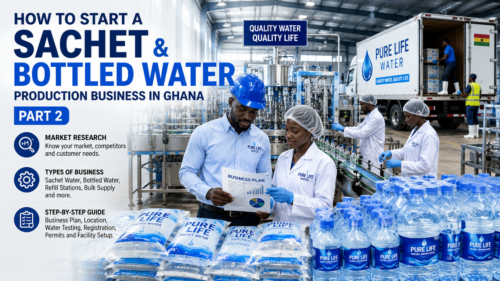










Market Research Before You Start
Every successful water production business begins with thorough market research. While the demand for clean drinking water is high across Ghana, not every location offers the same level of opportunity. Understanding your target market before investing can help you avoid costly mistakes and build a business that meets local demand.
Before purchasing equipment or renting a production facility, take time to study your intended market. Visit communities, speak with retailers, wholesalers, distributors, and consumers, and identify gaps that your business can fill.
Identify Your Target Market
Knowing who your customers are will influence everything from your packaging size to your pricing strategy and distribution channels.
Potential customers include:
- Households
- Schools and universities
- Hospitals and clinics
- Churches and mosques
- Government institutions
- Corporate offices
- Hotels and restaurants
- Supermarkets and provision shops
- Event organizers
- Drinking spots and food vendors
- Wholesalers and distributors
Some businesses may focus on supplying institutions through bulk contracts, while others may prioritize retail outlets or direct consumer sales.
Study Your Competitors
Competitor analysis helps you understand what already exists in your target area.
Consider the following:
- Which water brands dominate the market?
- What packaging sizes are most popular?
- How much do competitors charge?
- Which distribution channels do they use?
- What are customers saying about their products?
- Are there underserved communities with limited supply?
Learning from successful businesses allows you to identify opportunities to differentiate your brand rather than simply copying competitors.
Analyze Pricing
Pricing should strike a balance between profitability and affordability.
When researching prices, compare:
- Wholesale prices
- Retail prices
- Delivery charges
- Distributor margins
- Institutional contract prices
Remember that low prices alone do not guarantee success. Consumers often choose brands they trust for quality, hygiene, and reliability.
Understand Customer Preferences
Customer expectations continue to evolve.
Many buyers now consider:
- Taste
- Water clarity
- Packaging quality
- Brand reputation
- Availability
- Delivery reliability
- Regulatory approval
- Environmental responsibility
A strong understanding of customer preferences helps you create products that stand out in a competitive market.
Assess Distribution Opportunities
Producing quality water is only half the business. Your products must reach customers consistently.
Map out potential distribution routes and identify:
- Major markets
- Residential communities
- Retail clusters
- Schools
- Business districts
- Event centers
- Nearby towns
Efficient distribution reduces transportation costs while improving product availability.
Types of Water Production Businesses
The packaged drinking water industry offers several business models. Choosing the right one depends on your budget, target market, and long-term goals.
Sachet Water Production
This is the most common entry point for entrepreneurs because it generally requires less capital than bottled water production.
Advantages include:
- High daily demand
- Lower production cost
- Faster production
- Affordable retail pricing
- Easier market penetration
However, profitability depends on efficient production and a strong distribution network.
Bottled Water Production
Bottled water typically targets higher-income consumers and institutional buyers.
Common customers include:
- Hotels
- Restaurants
- Conference organizers
- Airlines
- Corporate offices
- Gyms
- Supermarkets
- Premium retail outlets
Although startup costs are usually higher, bottled water often provides better profit margins and stronger branding opportunities.
Combined Sachet and Bottled Water Production
Many established manufacturers operate both production lines.
Benefits include:
- Multiple revenue streams
- Broader customer reach
- Better utilization of production facilities
- Reduced business risk
- Greater opportunities for brand expansion
As your business grows, adding bottled water production can complement an already successful sachet water operation.
Water Refill Stations
Some entrepreneurs focus on providing purified water for customers who refill reusable containers.
This model:
- Requires less packaging
- Reduces plastic waste
- Appeals to environmentally conscious consumers
- Can generate steady local income
Bulk Water Supply
Bulk treated water can be supplied to:
- Construction companies
- Manufacturing firms
- Hotels
- Institutions
- Large events
Although less common than packaged water, it can become an additional income stream.
Private-Label Water Production
Businesses can also manufacture water under another company’s brand.
Potential clients include:
- Hotels
- Event organizers
- Supermarkets
- Corporate organizations
- Religious institutions
Private-label production allows factories to maximize equipment utilization while generating consistent revenue.
Comparison of Water Production Business Models
| Business Model | Startup Cost | Profit Potential | Scalability |
|---|---|---|---|
| Sachet Water | Moderate | High | High |
| Bottled Water | High | Very High | Very High |
| Combined Production | Higher | Excellent | Excellent |
| Water Refill Station | Low to Moderate | Moderate | Moderate |
| Bulk Water Supply | Moderate | High | High |
| Private-Label Production | Moderate | High | Excellent |
Step-by-Step Guide to Starting a Water Production Business in Ghana
Launching a successful water production business requires more than purchasing machinery. Careful planning and compliance with quality standards are essential.
Step 1: Develop a Business Plan
A business plan serves as the roadmap for your enterprise.
It should include:
- Business objectives
- Products to be produced
- Target market
- Marketing strategy
- Distribution plan
- Estimated startup costs
- Operating expenses
- Sales projections
- Cash flow forecast
- Break-even analysis
- Risk management plan
A well-prepared business plan is also valuable when seeking funding from banks or investors.
Step 2: Choose the Right Location
Location plays a significant role in operational efficiency and distribution.
Consider locations that offer:
- Reliable access to a suitable water source
- Good road networks
- Adequate electricity supply
- Proper drainage and sanitation
- Space for production and storage
- Easy access for delivery vehicles
- Proximity to customers and distributors
Avoid locations that are difficult to access or prone to flooding.
Step 3: Identify and Test Your Water Source
The quality of your finished product depends heavily on the quality of the source water.
Potential sources include:
- Boreholes
- Municipal water supply
- Protected wells
- Other approved water sources
Regardless of the source, laboratory testing is essential.
Testing helps determine:
- Microbiological safety
- Chemical composition
- Mineral content
- pH level
- Treatment requirements
Never assume that water is safe simply because it appears clean. The appropriate treatment process should always be based on laboratory test results.
Step 4: Register Your Business
Register your business with the appropriate authorities before commencing operations.
Depending on your business structure and activities, you should verify current registration and regulatory requirements with the relevant institutions in Ghana, including:
- The Office of the Registrar of Companies
- Food and Drugs Authority (FDA)
- Ghana Standards Authority (GSA)
- Environmental Protection Agency (EPA), where applicable
- Metropolitan, Municipal, or District Assembly (MMDA)
- Other relevant regulatory bodies
Regulations, fees, and procedures may change over time, so always confirm current requirements directly with the relevant authorities before investing.
Step 5: Obtain Required Approvals
Before selling packaged drinking water, ensure your business obtains all necessary approvals and certifications required for legal operation.
This typically involves demonstrating that:
- Your production facility meets hygiene standards.
- Your water has undergone appropriate laboratory testing.
- Your products comply with applicable quality standards.
- Your packaging and labeling meet regulatory requirements.
Meeting these standards helps build consumer confidence and protects your business from regulatory issues.
Step 6: Set Up the Production Facility
A well-designed production facility improves efficiency, hygiene, and product quality.
Your facility should include dedicated areas for:
- Raw water storage
- Water treatment
- Production and packaging
- Finished goods storage
- Quality control
- Loading and dispatch
- Staff sanitation and changing rooms
Implement strict cleaning schedules, staff hygiene protocols, and preventive maintenance practices to reduce contamination risks and maintain consistent production quality.
Conclusion
Starting a sachet or bottled water production business in Ghana requires careful preparation, from conducting market research and selecting the right business model to choosing a suitable location, testing your water source, and complying with regulatory requirements. Entrepreneurs who invest time in planning and quality assurance are better positioned to build a trusted brand and achieve long-term success.